
Result
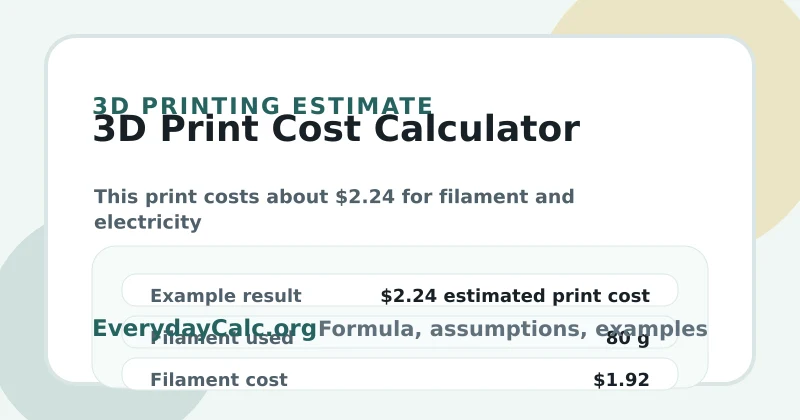
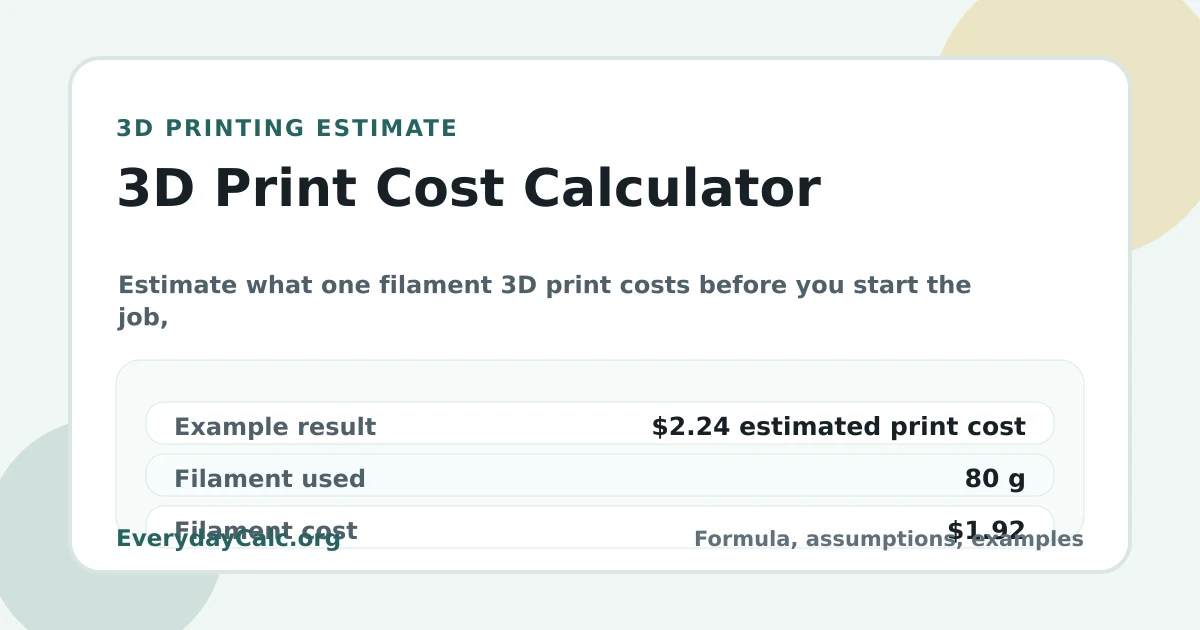
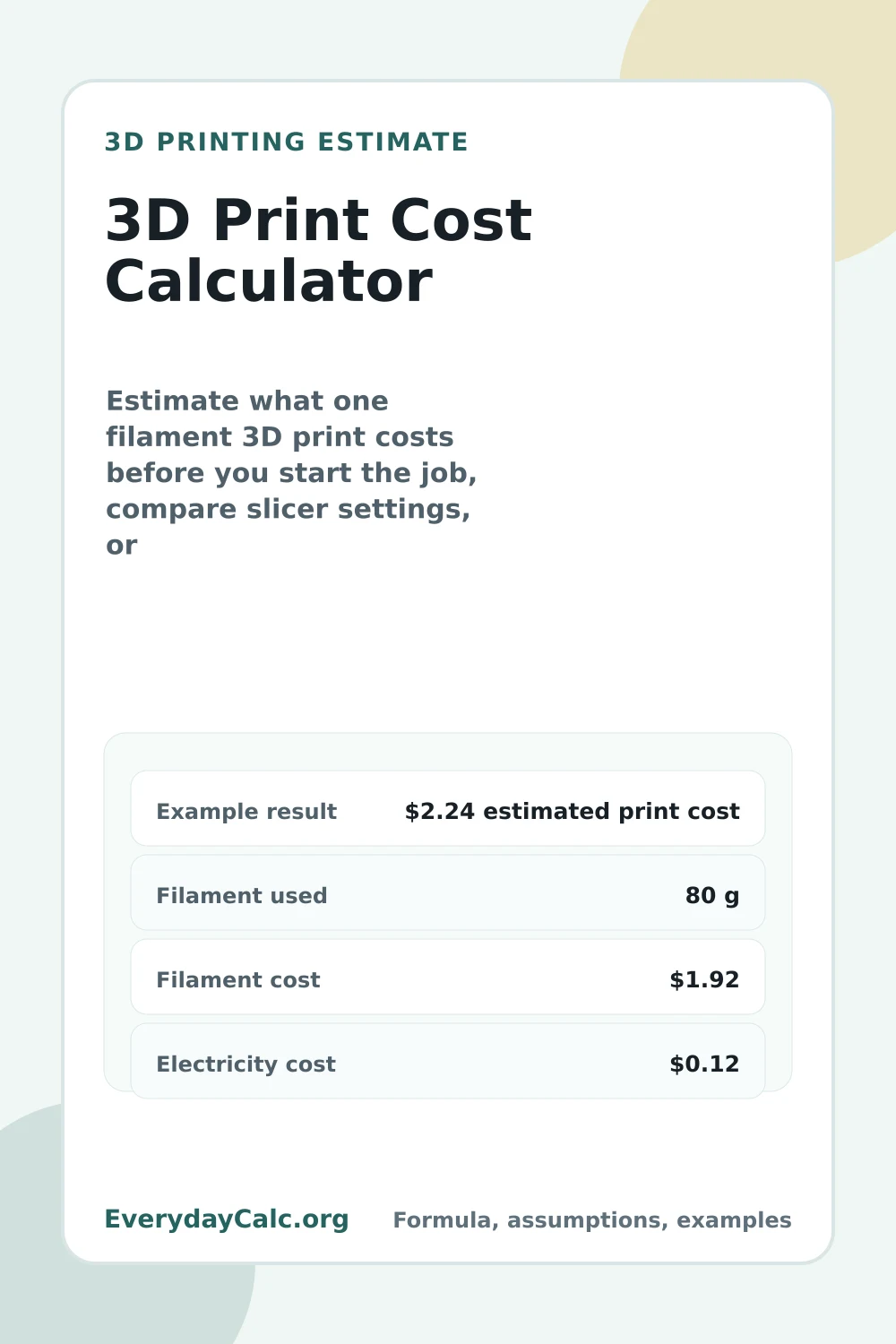
$2.24 estimated print cost
This print costs about $2.24 for filament and electricity before labor, machine wear, packaging, or seller margin.
- Filament cost
- $1.92
- Electricity cost
- $0.12
- Waste buffer cost
- $0.20
Estimate only. Verify slicer output, material condition, printer tuning, support settings, post-processing needs, and safety requirements before relying on this print estimate. Read the full disclaimer.
More
Optional equipment check
Use the material portion of the estimate to compare filament by polymer, diameter, net spool weight, tolerance, color consistency, printer compatibility, storage needs, and delivered cost per gram.
What to compare before buying
Quick answer
Quick answer
With the sample inputs, this calculator returns $2.24 estimated print cost. Filament cost: $1.92. Use $2.24 estimated print cost as a print-planning estimate, then check slicer settings, material condition, failed-print buffer, and any labor or post-processing time.
Publisher
Published by EverydayCalc Editorial
Our calculator pages are built to show the formula, explain the inputs, provide examples, and highlight assumptions so readers can understand how each result is estimated.
Results are estimates based on the inputs provided and the assumptions shown on this page. For financial, tax, legal, medical, or other high-stakes decisions, verify results with a qualified professional or official source.
How to use this calculator
The calculator divides spool price by spool grams to get material cost per gram, adds electricity from average watts and print time, then applies a waste or failure buffer.
When to round up
Round up for supports, brims, purge lines, prototype failures, wet filament, color swaps, and prints that need extra tuning.
When to use this calculator
- Estimating material, resin, or electricity before starting a print
- Comparing slicer settings such as infill, supports, scale, layer height, or speed
- Preparing a small seller quote or print-farm capacity estimate
Tips for better estimates
- Use slicer grams, resin milliliters, and print hours from the profile you will actually run.
- Add a buffer for supports, purge, failed first layers, resin cleanup, post-processing, and packaging.
- For quotes, separate material, electricity, labor, machine time, failure risk, and margin so you can adjust one assumption at a time.
How this calculator is reviewed
This page is checked for inputs, formulas, examples, assumptions, topic fit, and related links. For this calculator, the review also covers slicer grams, resin volume, print time, support settings, infill, layer height, failure buffer, machine time, and post-processing assumptions.
The sample result is covered by automated tests, and the page links to related calculators and, where available, supporting guides so readers can check the assumptions before acting. If a formula, label, or assumption looks off, send the page URL and your inputs through the contact page.
Formula and methodology
The calculator combines slicer output, material cost, print time, printer limits, or seller assumptions into a practical 3D printing estimate.
Result details: This page uses the inputs above to show filament cost, electricity cost, and waste buffer cost in the result area.
Assumptions to check
The key inputs are Filament used, Spool price, Spool size, Print time, Average printer draw. Confirm slicer output, material price, support settings, printer tuning, failure buffer, machine time, labor, post-processing, and packaging before relying on the estimate.
Worked example
Example inputs: Filament used: 80 g; Spool price: $24; Spool size: 1000 g; Print time: 6 hours; Average printer draw: 120 watts; Electricity rate: $0.16 /kWh; Failure/waste buffer: 10 %. With those values, the calculator returns $2.24 estimated print cost. This print costs about $2.24 for filament and electricity before labor, machine wear, packaging, or seller margin.
Example scenarios
- Use $2.24 estimated print cost as a print-planning estimate, then compare it with slicer grams, supports, material condition, and printer reliability.
- For seller quotes, add hands-on labor, machine time, failed-print waste, packaging, and payment fees before sharing a price.
- For slicer changes, rerun the estimate after changing infill, supports, layer height, scale, resin orientation, or print speed.
Quick reference chart
| Sample result | $2.24 estimated print cost |
|---|---|
| Filament cost | $1.92 |
| Electricity cost | $0.12 |
| Waste buffer cost | $0.20 |
| Best next step | Use $2.24 estimated print cost as a starting estimate, then compare it with the real conditions before acting. |
FAQs
3D Print Cost Calculator questions
Can I use this as a final shopping list?
Use it as a planning estimate, then compare the result with your measurements, product coverage, site conditions, full-unit sizes, and project instructions.
Should I add a safety margin?
Usually yes. Add a buffer for measurement error, damaged material, layout changes, products sold in full units, and the extra material that fits this specific project.
What should I check before buying?
Check measurements, product coverage, package size, prep needs, compatible tools, fasteners, trim pieces, or other supplies the project requires.
Can this replace professional construction advice?
No. For structural, electrical, plumbing, roofing, or safety-critical work, confirm with a qualified professional.
Is the 3d print cost calculator exact?
No. It is a 3D printing planning estimate. Slicer settings, material brand, humidity, printer tuning, supports, failures, and post-processing can change the real result.
What inputs matter most?
Filament grams, spool price, print time, printer watts, electricity rate, and waste buffer determine the cost.
Saved tools
Saved calculators
- No saved calculators yet.
Recent tools
Recent calculators
- Recent calculators will appear here.
Common planning mistakes
Using guessed material instead of slicer output, ignoring support or purge waste, underpricing labor, forgetting failed prints, and treating one tuned profile as reliable for every material.
Cite or embed this calculator
If this calculator helps a blog post, classroom resource, forum answer, seasonal guide, or local planning page, link to the canonical calculator URL so readers can run their own numbers and check the assumptions.
EverydayCalc.org, "3D Print Cost Calculator", last updated July 9, 2026, https://everydaycalc.org/calculators/3d-print-cost-calculator/Was this calculator helpful?
Suggest an improvementNotice an issue with this calculator? Contact us here.